






How to Read Restaurant Reviews Like a Pro
Choosing a restaurant is easier than ever thanks to online reviews. Whether you’re looking for a cozy café, a fine dining experience, or the best local food spot, reviews can help you decide where to eat. However, not every review tells the full story. Some reviews are overly emotional, some may be fake, and others focus on personal preferences rather than the actual quality of the restaurant.
Learning how to read restaurant reviews like a pro helps you separate useful information from noise. Instead of simply looking at the star rating, you’ll understand what really matters—food quality, service consistency, cleanliness, value for money, and customer experience.
In this guide, you’ll discover practical tips to evaluate restaurant reviews the smart way.
Why Restaurant Reviews Matter
Restaurant reviews provide real customer experiences that can help you:
- Avoid disappointing restaurants
- Discover hidden gems
- Find restaurants matching your budget
- Learn about portion sizes
- Understand service quality
- Check cleanliness standards
- Know if reservations are necessary
Good reviews offer valuable insights that restaurant websites often don’t mention.
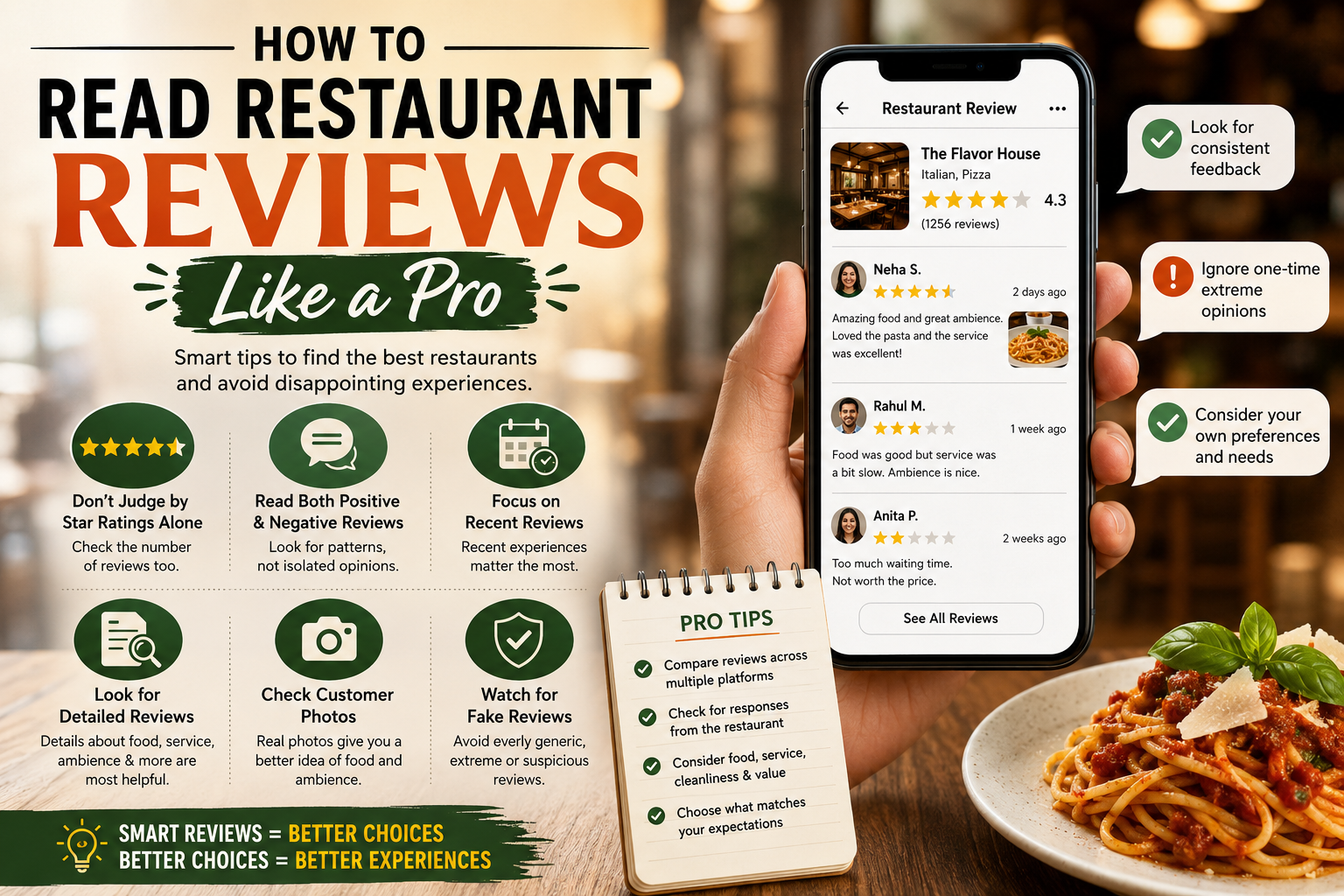
Don’t Judge a Restaurant by Star Ratings Alone
One of the biggest mistakes diners make is focusing only on the overall rating.
For example:
- ⭐⭐⭐⭐⭐ (5.0 from 12 reviews)
- ⭐⭐⭐⭐☆ (4.4 from 2,300 reviews)
The second restaurant is usually a more reliable choice because hundreds or thousands of customers have shared their experiences.
A restaurant with many positive reviews is generally more trustworthy than one with only a few perfect ratings.
Read Both Positive and Negative Reviews
Many people only read the highest-rated reviews.
Instead, spend time reading:
- 5-star reviews
- 4-star reviews
- 3-star reviews
- 2-star reviews
- 1-star reviews
This helps you identify recurring patterns.
For example:
Positive reviews repeatedly mention:
- Fresh food
- Friendly staff
- Fast service
- Beautiful atmosphere
Negative reviews repeatedly mention:
- Long waiting times
- Cold food
- Poor hygiene
- Overpriced menu
When multiple reviewers mention the same issue, it’s more likely to be accurate.
Look for Recent Reviews
Restaurants can change over time.
A restaurant with amazing reviews from three years ago may have:
- New management
- Different chefs
- Updated menu
- Better service
- Worse quality
Always prioritize reviews from the last few weeks or months.
Recent reviews provide a more accurate picture of the current dining experience.
Pay Attention to Detailed Reviews
The most useful reviews explain why customers enjoyed or disliked their visit.
Helpful reviews often include details like:
- What dishes they ordered
- Waiting time
- Staff behavior
- Portion size
- Food presentation
- Cleanliness
- Parking availability
- Ambience
Identify Common Complaints
One angry customer doesn’t necessarily mean the restaurant is bad.
Instead, check whether multiple people report the same issue.
Examples include:
- Slow service
- Dirty tables
- Incorrect orders
- Cold food
- Poor customer service
- Hidden charges
If dozens of customers mention the same problem, take it seriously.
Watch for Fake Reviews
Unfortunately, fake reviews exist.
Some signs include:
- Extremely generic language
- No specific food mentioned
- Multiple similar reviews posted together
- Brand-new reviewer accounts
- Overly promotional wording
- Unrealistic praise
Likewise, fake negative reviews may include exaggerated complaints without details.
Trust balanced reviews that discuss both strengths and weaknesses.
Check Customer Photos
Photos uploaded by diners are often more reliable than professional marketing images.
Customer photos help you evaluate:
- Food presentation
- Portion sizes
- Restaurant cleanliness
- Seating arrangement
- Lighting
- Ambience
Real images usually provide a more honest impression.
Consider the Reviewer’s Preferences
Not every negative review applies to you.
For example:
Someone may complain because:
- Food was too spicy
- Restaurant was too quiet
- Menu had limited vegan options
- Portions were too large
These may not matter to your dining preferences.
Always consider whether the review matches your own expectations.
Look Beyond Food Quality
A great dining experience involves more than delicious food.
Check reviews for:
Service
Look for comments about:
- Friendly staff
- Helpful servers
- Professional behavior
- Fast service
Cleanliness
Reviews mentioning clean:
- Tables
- Washrooms
- Kitchen visibility
- Dining area
are positive indicators.
Atmosphere
Consider:
- Music volume
- Lighting
- Interior design
- Family-friendly environment
- Romantic setting
- Outdoor seating
Value for Money
Some restaurants are expensive but worth every penny.
Others may charge premium prices without offering exceptional quality.
Reviews often reveal whether customers feel satisfied with the overall value.
Compare Reviews Across Multiple Platforms
Different review platforms often attract different audiences.
Compare opinions from:
- Google Reviews
- TripAdvisor
- Yelp
- Zomato
- OpenTable
If multiple platforms tell a similar story, the information is usually more reliable.
Look for Responses from Restaurant Owners
Professional restaurants often respond politely to customer feedback.
Good signs include:
- Thanking customers
- Apologizing for mistakes
- Offering solutions
- Explaining improvements
Owner responses show that the restaurant values customer satisfaction.
Don’t Ignore Medium Ratings
Three-star reviews are often the most balanced.
These reviews usually discuss:
- What was good
- What could improve
- Whether they’d return
They tend to provide more objective information than extreme ratings.
Consider the Type of Restaurant
Expectations vary depending on the restaurant.
For example:
Fine Dining
Expect:
- Elegant presentation
- Professional service
- Premium pricing
- Longer dining experience
Casual Dining
Focus on:
- Consistent food quality
- Friendly staff
- Comfortable seating
- Fair prices
Fast Food
Look for:
- Speed
- Accuracy
- Cleanliness
- Freshness
Judge reviews according to the restaurant category.
Check Menu Mentions
If dozens of reviewers recommend the same dishes, that’s a positive sign.
Examples:
- Signature burgers
- Handmade pasta
- Seafood platter
- Butter chicken
- Wood-fired pizza
- Chocolate lava cake
Popular menu items are often the safest choices for first-time visitors.
Understand Seasonal Factors
Holiday periods may affect:
- Waiting time
- Food quality
- Staff availability
- Reservation difficulty
Reviews from peak seasons may differ from regular weekdays.
Balance Quantity and Quality of Reviews
Consider both:
- Total review count
- Average rating
- Review consistency
Consistency over time is more valuable than perfection.
Red Flags to Watch For
Avoid restaurants where reviews repeatedly mention:
- Poor hygiene
- Food poisoning concerns
- Hidden charges
- Rude staff
- Incorrect billing
- Extremely long waits
- Fake advertising
- Unsafe environment
Repeated serious complaints should not be ignored.
Signs of an Excellent Restaurant
Positive review patterns often include:
- Consistently fresh food
- Friendly staff
- Fair pricing
- Clean environment
- Comfortable seating
- Fast service
- Accurate orders
- Repeat customers
- Great atmosphere
- Strong recommendations
Pro Tips for Reading Reviews
- Read at least 15–20 reviews before deciding.
- Focus on reviews from the past six months.
- Look for recurring themes rather than isolated complaints.
- Trust detailed reviews over emotional reactions.
- Check customer-uploaded photos.
- Compare multiple review platforms.
- Match reviews with your dining preferences.
- Ignore suspiciously perfect ratings.
Common Mistakes to Avoid
- Choosing based only on star ratings.
- Reading only positive reviews.
- Ignoring recent feedback.
- Believing every negative review.
- Overlooking customer photos.
- Not comparing different review websites.
- Ignoring recurring complaints.
Final Thoughts
Knowing how to read restaurant reviews like a pro can save you time, money, and disappointment. Instead of relying solely on star ratings, pay attention to detailed experiences, recent feedback, recurring themes, customer photos, and owner responses. By taking a few extra minutes to evaluate reviews carefully, you’ll make smarter dining choices and enjoy more satisfying restaurant experiences.
Frequently Asked Questions (FAQs)
1. Why shouldn’t I rely only on star ratings?
Star ratings provide a quick overview, but they don’t explain the reasons behind customer experiences. Reading detailed reviews gives better context.
2. How many reviews should I read before choosing a restaurant?
Aim to read at least 15–20 reviews, including both positive and negative ones, to identify consistent patterns.
3. How can I spot fake restaurant reviews?
Look for overly generic language, repeated phrases, extreme praise or criticism without details, and accounts with very few contributions.
4. Are recent reviews more important than older ones?
Yes. Restaurants can change management, chefs, menus, or service quality, so recent reviews better reflect the current experience.
5. Should I trust customer photos?
In most cases, yes. Customer-uploaded photos often show the real presentation, portion sizes, and atmosphere more accurately than promotional images.
Disclaimer
This article is intended for informational purposes only. Restaurant reviews reflect individual opinions and experiences, which may vary from person to person. Always use multiple sources, consider your personal preferences, and verify current details such as menus, pricing, and operating hours before visiting a restaurant.