






Bangalore has no shortage of Kerala restaurants. Between the city’s large Malayali population and its steady appetite for regional Indian cuisines, you’ll find everything from small darshini-style Kerala meals joints to full-service multi-cuisine restaurants claiming to serve “authentic Kerala food.” Against this crowded backdrop, Thalassery Restaurant has managed to carve out a distinct identity across its many Bangalore outlets. But what exactly sets it apart from the dozens of other Kerala eateries competing for the same customers? This article breaks down the specific factors — regional specificity, menu structure, pricing philosophy, community role, and format — that distinguish Thalassery Restaurant from the broader field of Kerala restaurants in the city.
1. It’s Named After a Region, Not a Generic Identity
Most Kerala restaurants brand themselves with broad, generic names — “Kerala Kitchen,” “God’s Own Cuisine,” “Malabar House,” and similar labels that signal the state but nothing more specific. Thalassery Restaurant does something different: it names itself directly after Thalassery, a coastal town in Kerala’s Kannur district with one of the most distinctive and well-documented culinary traditions in the state.
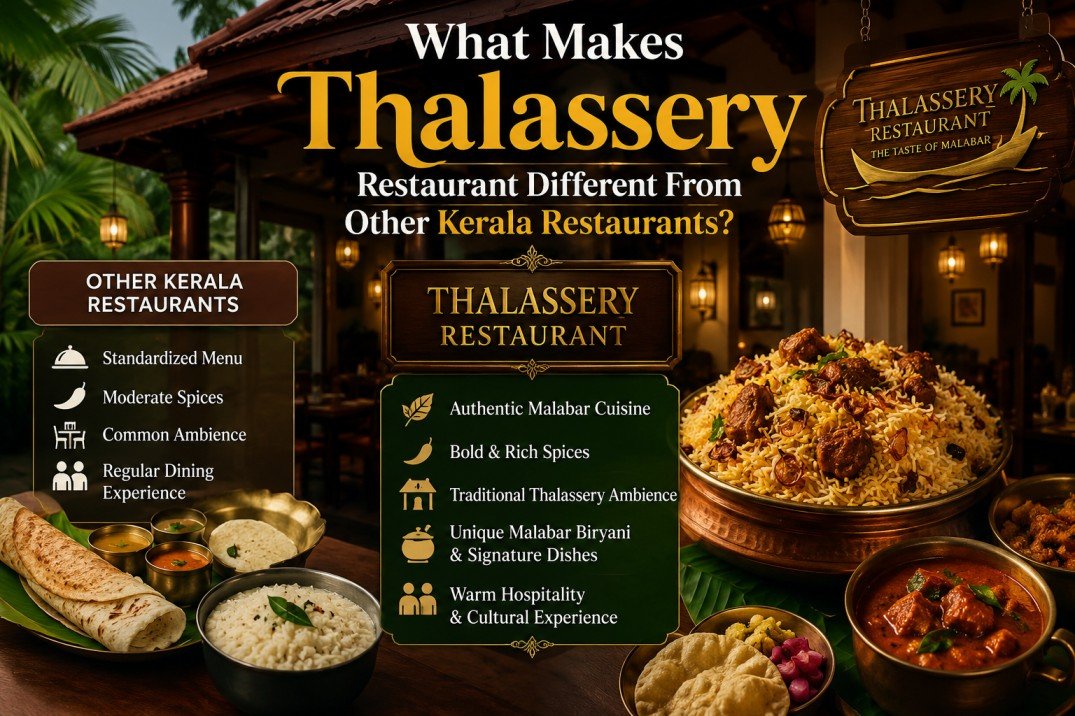
This isn’t just a branding choice — it’s a statement of specificity. Thalassery cuisine is recognized across South India as its own sub-tradition within Kerala food, shaped by centuries of Arab trade influence, a unique spice-blending approach, and cooking techniques that differ meaningfully from those used in Kottayam, Kochi, or Thiruvananthapuram-style Kerala cooking. By naming itself after this specific region, the restaurant sets an expectation of a particular culinary style, rather than a vague, catch-all “Kerala food” experience. Diners walking in already know, at least in theory, that they’re getting Malabar-region cooking rather than a broader Kerala buffet of styles blended together.
2. The Signature Biryani Is Genuinely Different
Biryani is where this distinction matters most. Many Kerala restaurants serve a “Kerala biryani” that’s really just a mild variation on the more familiar Hyderabadi or Lucknowi styles, built on long-grain basmati rice. Thalassery-style biryani, by contrast, uses short-grain khyma (or jeerakasala) rice, a much smaller and more fragrant grain that behaves differently during cooking and absorbs spice in a distinct way. It also tends to be layered with a different blend of whole spices and cooked using techniques passed down specifically within the Malabar tradition.
Across reviews of Thalassery Restaurant’s various outlets, the biryani is consistently singled out as the standout dish, and diners repeatedly describe it as recognizably different from the biryanis available at other Kerala or multi-cuisine restaurants nearby. Some outlets go a step further and offer kappa (tapioca) biryani, an even more regionally specific dish rarely found outside dedicated Malabar establishments. This narrow, well-executed focus on one very specific style of biryani — rather than a generic “Kerala biryani” — is one of the clearest ways the restaurant differentiates itself.
3. A Breakfast-Forward Menu Philosophy
Many Kerala restaurants in Bangalore treat breakfast items like appam, idiyappam, and puttu as a small side section of a much larger, dinner-oriented menu. Thalassery Restaurant, by contrast, treats these dishes as central rather than secondary. Appam and puttu paired with kadala curry or stew appear again and again in customer feedback as reasons people return, not as an afterthought but as a defining part of the experience.
This matters because it reflects an entirely different philosophy of what a “Kerala restaurant” should prioritize. Rather than positioning itself primarily as a dinner destination with a few breakfast items tacked on, Thalassery Restaurant leans into the idea that Kerala’s breakfast culture — built around steamed rice-based dishes, coconut, and simple, comforting curries — deserves as much attention as its curries and rice dishes. For many regulars, especially the Malayali community, this is precisely the point: a place where you can get proper appam and puttu any time of day, not just during a narrow breakfast window.
4. It Operates as an Accessible, Neighborhood-Level Chain
One of the most structurally distinct things about Thalassery Restaurant is its format. Rather than existing as a single flagship location that diners travel across the city to visit, it operates as a spread-out network of outlets across Bangalore — Kammanahalli, Mathikere, Whitefield, Marathahalli, Bellandur, Bannerghatta Road, Frazer Town, Kengeri, Electronic City, and more.
This is a meaningfully different model from many well-known Kerala restaurants in the city, which tend to operate as a small number of standalone locations, often concentrated in specific pockets known for a Malayali population (such as areas near the CBD or IT corridors). Thalassery Restaurant’s wider distribution means it functions less like a special-occasion destination and more like a dependable, everyday neighborhood option — closer in spirit to how idli-vada darshinis serve South Indian breakfast across the city than to how a single celebrated restaurant serves a specific cuisine from one location.
This has trade-offs, which are explored further below, but the accessibility itself is a genuine point of difference: very few Kerala restaurants in Bangalore have achieved this level of geographic spread while still maintaining a focused regional identity.
5. Pricing Built for Frequent, Everyday Visits
Many Kerala specialty restaurants — particularly ones emphasizing premium seafood or a more polished dining room — price themselves toward the mid-to-upper range, positioning the cuisine as something you’d order for a special weekend outing. Thalassery Restaurant’s pricing structure, by contrast, is built around everyday affordability. Staples like appam (around ₹25) and puttu (around ₹80) are priced low enough to order casually, rather than as an occasional indulgence. Even a fuller meal with biryani or a chicken curry rarely pushes into expensive territory unless you’re specifically ordering premium seafood preparations like karimeen or pomfret pollichathu.
This pricing philosophy reinforces the restaurant’s positioning as a frequent, casual dining option rather than an event-driven destination. It’s a subtle but important difference: restaurants aiming for special-occasion status often price their menus to match that positioning, while Thalassery Restaurant’s pricing signals that it wants to be part of a customer’s regular rotation, not just an occasional treat.
6. A Deliberate Blend of Regional Authenticity and Broader Appeal
While the core identity is built around Malabar cuisine, most Thalassery Restaurant outlets also offer a substantial range of North Indian tandoori items, Chinese dishes, and soups. This is a departure from many dedicated Kerala restaurants, which tend to stay narrowly focused on their regional cuisine as a point of pride and differentiation from generic multi-cuisine competitors.
At first glance, this might seem like it dilutes the restaurant’s regional identity. But in practice, it reflects a specific strategic choice: rather than asking every visitor in a mixed group to commit fully to Malabar cuisine, Thalassery Restaurant gives group diners — a common scenario in office lunches or family outings — the flexibility to order a chicken tikka or fried rice alongside someone else’s appam and curry. Few dedicated Kerala restaurants manage this balance as consistently; most either stay narrowly regional or drift into being predominantly multi-cuisine with only a token nod to Kerala dishes. Thalassery Restaurant’s menu structure suggests an attempt to keep the Malabar dishes as the clear centerpiece while still accommodating diners who want something more familiar.
7. A Genuine Cultural Anchor for the Malayali Community
Several reviews of Thalassery Restaurant specifically highlight its role as a touchpoint for Malayalis living in Bangalore — mentioning details like the availability of boiled rice (a staple in many Kerala households but uncommon at other restaurants in the city) and appreciating the chance to get home-style dishes not easily found elsewhere. This kind of specific, community-oriented detail is a meaningful differentiator. Plenty of restaurants describe themselves as serving “authentic” Kerala food, but the recurring, specific mentions of small details like boiled rice availability suggest a menu genuinely built around what the Malayali community actually eats at home, rather than a version of Kerala cuisine adapted for a broader, less specific audience.
8. Consistency Varies — And That’s Also a Distinguishing Factor
To give a fair and complete picture, it’s worth acknowledging that Thalassery Restaurant’s multi-outlet format cuts both ways. Because each branch operates somewhat independently, the experience isn’t uniform. Some outlets — Kammanahalli and Frazer Town, for example — consistently earn strong praise for taste, portion size, and service speed. Others have drawn more mixed or critical feedback, including concerns about food quality and hygiene at certain locations.
This variability is itself a point of difference from Kerala restaurants that operate as a single, tightly controlled location, where quality tends to be more consistent simply because there’s one kitchen and one team responsible for the entire operation. A single-location Kerala restaurant might have a smaller footprint, but it typically offers a more predictable experience precisely because it isn’t managing the complexity of multiple kitchens across the city. Thalassery Restaurant trades some of that consistency for far greater accessibility — a genuine trade-off rather than an unambiguous advantage, and one worth knowing about before you commit to a specific branch based on reputation built elsewhere in the city.
9. A Focus on Malabar-Specific Ingredients and Preparations
Beyond the biryani, several dishes on Thalassery Restaurant’s menu reflect ingredients and techniques more specific to the Malabar coast than to Kerala cuisine broadly. Duck roast, for instance, is a dish more strongly associated with Kerala’s northern Malabar region than with the southern parts of the state, and it appears as a recurring recommendation in customer reviews. Similarly, preparations like koonthal (squid) roast and netholi (anchovy) fry reflect specific coastal ingredient choices rather than the more generalized “Kerala seafood” offerings found at many multi-cuisine restaurants that include a token fish curry on an otherwise unrelated menu.
This attention to specific regional ingredients — rather than a broad, undifferentiated approach to “Kerala seafood” or “Kerala non-veg” — reinforces the restaurant’s positioning as something more particular than a generic Kerala eatery, even amid its broader multi-cuisine additions.
10. Sulaimani as a Signature, Rather Than an Afterthought
Many Kerala restaurants offer chai or basic beverages as an incidental part of the menu. Thalassery Restaurant consistently features sulaimani — a spiced, lightly sweetened black tea strongly associated with the Malabar region’s Muslim culinary tradition — as a recommended and recurring order, rather than a token beverage listing. Its consistent mention across reviews as a fitting way to end a meal suggests it functions as something closer to a signature offering than a generic add-on, again reinforcing the restaurant’s Malabar-specific identity rather than a broader, less defined “Kerala restaurant” positioning.
Putting It All Together
What separates Thalassery Restaurant from the wider field of Kerala restaurants in Bangalore isn’t a single dramatic difference — it’s a combination of smaller, deliberate choices that add up to a distinct identity:
- A name and menu built around a specific Malabar sub-region rather than a generic “Kerala” label
- A biryani style genuinely different in rice, spicing, and technique from the more commonly available Hyderabadi-influenced versions
- A breakfast-forward menu philosophy that treats appam, idiyappam, and puttu as central rather than secondary
- An accessible, multi-outlet format that prioritizes everyday convenience over destination-dining status
- Pricing designed for frequent visits rather than occasional indulgence
- A deliberate blend of regional specificity with broader multi-cuisine appeal for mixed groups
- A genuine cultural role for Bangalore’s Malayali community, reflected in specific menu choices like boiled rice availability
- Ingredient and dish choices — duck roast, koonthal roast, sulaimani — that reflect Malabar specificity rather than generalized Kerala fare
Of course, this comes with a real trade-off: the multi-outlet model means consistency varies by location in a way that a single, tightly run Kerala restaurant typically wouldn’t. But for diners who value regional specificity, everyday accessibility, and a menu built around genuine Malabar traditions rather than a generalized version of Kerala cuisine, Thalassery Restaurant occupies a distinct and recognizable place in Bangalore’s dining scene — one shaped as much by its regional focus as by its willingness to meet a broad range of everyday dining needs across the city.
Frequently Asked Questions
1. Is Thalassery cuisine the same as general Kerala cuisine?
Not exactly. Thalassery cuisine is a specific regional tradition from Kerala’s Malabar coast, shaped by distinct spicing, rice choices, and historical trade influences, making it a sub-tradition within the broader umbrella of Kerala food rather than identical to it.
2. Why is Thalassery biryani different from other Kerala or Hyderabadi biryanis?
It uses short-grain khyma rice rather than long-grain basmati, along with a distinct spice-layering technique associated specifically with the Malabar region, giving it a different texture and flavor profile.
3. Does Thalassery Restaurant serve only Kerala food?
No. While Malabar dishes form the core of the menu, most outlets also offer North Indian tandoori items, Chinese dishes, and soups to accommodate mixed groups and broader tastes.
4. Why does Thalassery Restaurant have so many outlets across Bangalore?
Its business model prioritizes accessibility and everyday convenience over operating as a single destination restaurant, allowing it to serve neighborhoods across the city rather than concentrating in one location.
5. Is food quality the same at every outlet?
Not entirely. Because outlets operate somewhat independently, feedback on food quality and service varies by branch, so it’s worth checking reviews for your specific nearby location.
6. What dishes best reflect the restaurant’s Malabar identity?
Thalassery-style biryani, duck roast, koonthal roast, netholi fry, and sulaimani are among the dishes most closely tied to the specific Malabar culinary tradition.
7. Is Thalassery Restaurant a good choice for someone new to Kerala food?
Yes. Its accessible pricing and breakfast-forward staples like appam and puttu make it an easy, low-commitment way to sample authentic Malabar dishes for the first time.
8. Why is appam and puttu given so much emphasis on the menu?
The restaurant treats Kerala’s breakfast tradition as central rather than secondary, offering these dishes throughout the day rather than confining them to a limited breakfast window, unlike many restaurants that treat them as a minor side section.
9. Is sulaimani different from regular chai?
Yes. Sulaimani is a spiced, lightly sweetened black tea associated specifically with Malabar’s culinary tradition, distinct from the milk-based chai served at most general restaurants.
10. Does the multi-outlet model affect pricing?
Prices vary somewhat by outlet, but the overall philosophy across branches favors affordability suited to frequent, everyday visits rather than special-occasion pricing.