






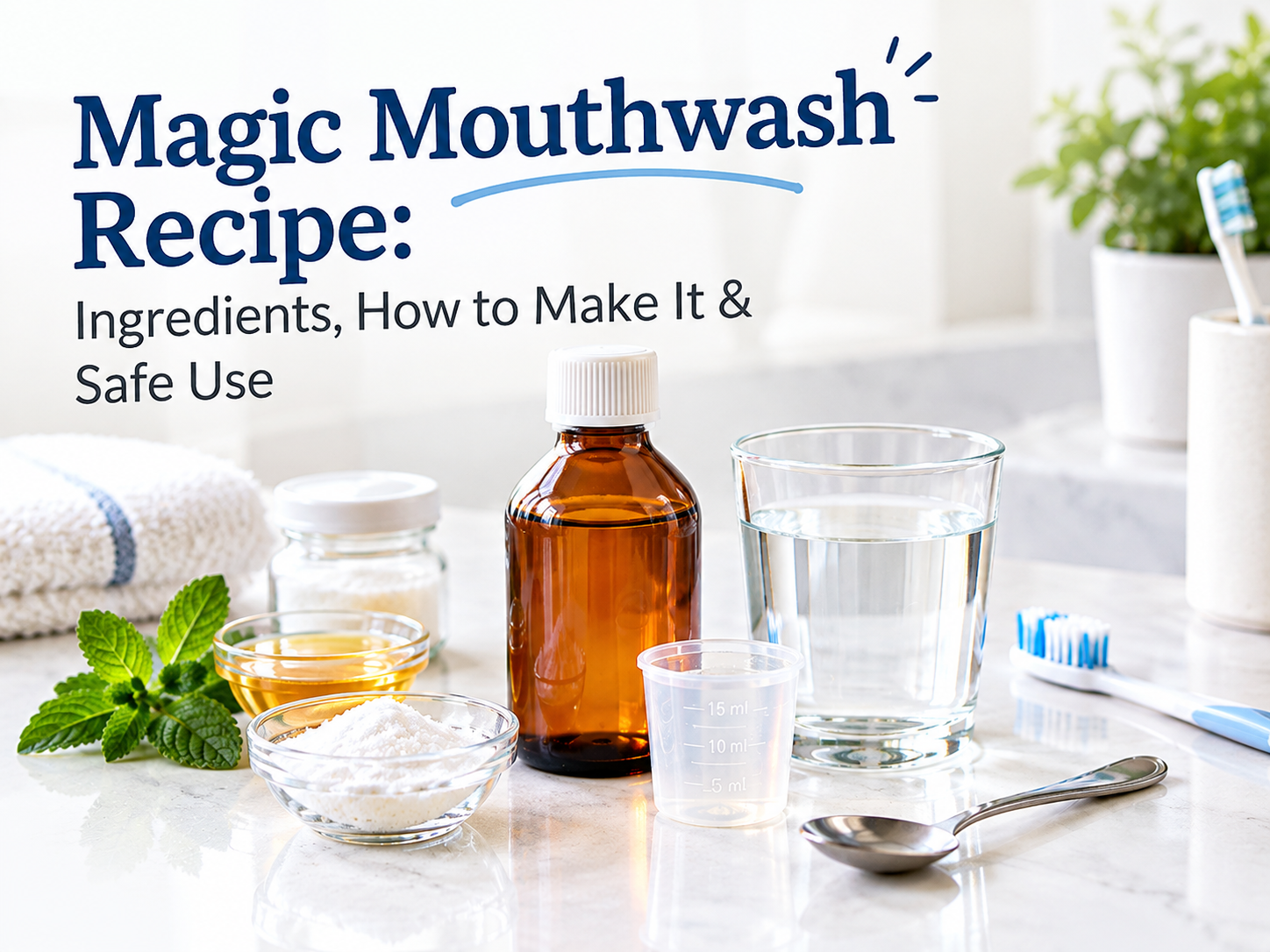
Magic mouthwash is a specially prepared oral rinse used to help relieve painful mouth sores, irritation, and oral mucositis. It is particularly associated with mouth sores caused by chemotherapy or radiation therapy, although healthcare professionals may recommend different formulations depending on the underlying problem.
If you searched for a magic mouthwash recipe, it is important to know that there is no single universal recipe. Different formulations can contain different medications, and some ingredients require a prescription or pharmacist compounding.
This guide explains what magic mouthwash is, the ingredients commonly used, how it is prepared professionally, how it is generally used, and safer alternatives for mild mouth irritation.
What Is Magic Mouthwash?
Magic mouthwash is a medicated oral rinse designed to provide symptomatic relief from painful mouth sores and inflammation.
The name “magic mouthwash” does not refer to one standardized product. Instead, it describes a group of compounded oral rinses that may contain several different types of ingredients.
Depending on the patient’s symptoms, a formulation may include:
- A numbing medicine to reduce pain
- An antihistamine or anticholinergic ingredient
- An antacid or coating ingredient
- An antifungal medication
- A corticosteroid
- An antibiotic
- An antiviral medication
Not every formulation contains all of these ingredients. The exact combination depends on the person’s condition and the healthcare professional’s recommendation.
Magic Mouthwash Ingredients
There is no single ingredient list that applies to every magic mouthwash.
Some commonly used components include the following.
1. Diphenhydramine
Diphenhydramine is an antihistamine that may be included in some formulations to help provide symptomatic relief.
2. Lidocaine
Lidocaine is a local anesthetic that can temporarily numb painful areas inside the mouth.
Because numbness can affect the ability to feel heat, sharp foods, or accidental bites, lidocaine-containing rinses should be used only as directed by a healthcare professional.
3. Antacid or Coating Agent
An antacid may be included to help the medication spread over and coat the tissues inside the mouth.
4. Antifungal Medicine
Some formulations contain an antifungal medication such as nystatin when fungal infection or yeast overgrowth is part of the problem.
The National Cancer Institute describes one magic-mouthwash formulation containing diphenhydramine, dexamethasone, and nystatin.
5. Corticosteroid
A corticosteroid may be used in certain formulations to help reduce inflammation and irritation.
6. Other Medications
Depending on the cause of the mouth sores, a healthcare professional may consider other medications, including antibiotics or antiviral medicines.
Is There a Standard Magic Mouthwash Recipe?
No. There is not one standard magic mouthwash recipe.
This is one of the most important things to understand before trying to make one at home.
Different pharmacies and healthcare professionals may use different formulations. The ingredients and concentrations can also change depending on whether the mouth sores are related to chemotherapy, radiation therapy, infection, inflammation, or another condition.
For this reason, copying a recipe from the internet and combining prescription or medicated products yourself can be unsafe.
A pharmacist can prepare a compounded formulation according to a prescription or specific healthcare instructions.
How Is Magic Mouthwash Made?
When a healthcare professional recommends magic mouthwash, the formulation is generally prepared by a pharmacy according to the prescribed ingredients and concentrations.
The preparation may involve combining several compatible medications into an oral suspension or rinse.
Because the formulation can contain medicines such as local anesthetics, antifungals, corticosteroids, or other active ingredients, the exact quantities should not be guessed or substituted.
Do not use a homemade combination of prescription medicines unless your doctor or pharmacist has specifically provided instructions for that formulation.
How to Use Magic Mouthwash
Instructions depend on the exact formulation.
Mayo Clinic notes that magic mouthwash is commonly used every 4 to 6 hours, although the appropriate frequency and amount depend on the specific product and the patient’s condition.
General instructions may include:
- Shake the bottle if the product instructions say to do so.
- Measure the prescribed amount carefully.
- Swish the solution around the mouth as directed.
- Keep it in contact with the affected areas for the recommended amount of time.
- Spit out the rinse if instructed not to swallow it.
- Avoid eating or drinking for about 30 minutes afterward when advised.
Always follow the directions printed on your prescription or provided by your doctor or pharmacist rather than relying on a generic internet recipe.
Can You Make Magic Mouthwash at Home?
This depends on what someone means by “magic mouthwash.”
A simple homemade mouth rinse made from salt or baking soda is not the same thing as prescription magic mouthwash.
For mild mouth irritation, a bland saltwater or baking-soda rinse may sometimes be recommended as supportive oral care. The National Cancer Institute describes bland saline and sodium-bicarbonate rinses as options used in oral-care protocols for mucositis.
However, adding medications such as lidocaine, steroids, antifungals, antibiotics, or other drugs should not be done by guessing measurements from an online recipe.
A Simple Non-Medicated Mouth Rinse
If you are looking for a gentle homemade rinse rather than a medicated magic mouthwash, a bland salt-and-baking-soda rinse may be an option for some people.
One NCI oral-care protocol describes mixing:
- 1 teaspoon salt
- 1 teaspoon baking soda
- 4 cups of water
The mixture can be used as a bland mouth rinse several times a day as directed by a healthcare professional.
This is not magic mouthwash and does not contain prescription medications.
What Is Magic Mouthwash Used For?
Magic mouthwash is most commonly discussed in connection with painful oral mucositis.
Mouth sores can develop during certain cancer treatments and may make eating, drinking, speaking, or swallowing uncomfortable.
Magic mouthwash may help reduce symptoms, particularly pain and irritation, but its effectiveness can vary because formulations differ. Mayo Clinic notes that studies have not established that magic mouthwash prevents mouth sores or makes them heal faster.
Magic Mouthwash for Chemotherapy Mouth Sores
Chemotherapy can cause painful changes to the lining of the mouth.
When this happens, a healthcare professional may recommend an oral-care routine that includes gentle cleaning, appropriate rinses, pain management, and other supportive treatments.
Magic mouthwash may be prescribed in some situations to help manage symptoms.
However, the best treatment depends on the type and severity of the mouth sores and the cancer treatment being received.
Magic Mouthwash for Radiation Mouth Sores
Radiation therapy involving the head and neck can also cause oral mucositis.
Clinical research has found that some magic-mouthwash formulations can reduce pain associated with radiation-related oral mucositis, although results can vary depending on the formulation and situation.
Patients receiving radiation therapy should discuss persistent or severe mouth sores with their oncology team rather than relying solely on a homemade rinse.
Magic Mouthwash Side Effects
Possible side effects depend on the ingredients in the particular formulation.
Reported effects can include:
- Temporary numbness
- Burning or tingling
- Changes in taste
- Drowsiness
- Upset stomach
- Diarrhea
- Constipation
Mayo Clinic specifically notes that side effects can vary because magic mouthwash formulas vary.
If a rinse causes significant swelling, difficulty breathing, severe irritation, worsening pain, or another concerning reaction, stop using it and seek medical advice promptly.
Foods to Avoid When You Have Mouth Sores
When your mouth is sore, certain foods can make symptoms worse.
Consider avoiding:
- Very spicy foods
- Acidic foods
- Very salty foods
- Hard or crunchy foods
- Extremely hot foods and drinks
- Alcohol
- Alcohol-containing mouthwashes
Instead, softer foods served at a comfortable temperature may be easier to tolerate. Mayo Clinic and the National Cancer Institute recommend avoiding foods and drinks that can further irritate oral mucositis.
Magic Mouthwash vs. Saltwater Rinse
These two rinses are not the same.
| Feature | Magic Mouthwash | Saltwater Rinse |
|---|---|---|
| Type | Medicated/compounded rinse | Bland homemade rinse |
| Ingredients | Varies by formulation | Salt and water |
| Prescription | Often prescribed or pharmacist-compounded | Generally does not require prescription |
| Main purpose | Symptom relief for specific oral conditions | Gentle oral care and comfort |
| Formula | Not standardized | Simple |
| Should medications be added at home? | No | Not applicable |
A saltwater rinse may be appropriate for basic oral care, while magic mouthwash may be selected when medication-based symptom management is needed.
When Should You Talk to a Doctor or Dentist?
Contact a healthcare professional if mouth sores:
- Are severe or getting worse
- Make eating or drinking difficult
- Cause significant bleeding
- Continue without improving
- Are accompanied by fever
- Occur during chemotherapy or radiation treatment
- Make swallowing difficult
- Keep returning frequently
People undergoing cancer treatment should tell their oncology team about new or worsening mouth sores.
Frequently Asked Questions About Magic Mouthwash
What is the best magic mouthwash recipe?
There is no single best recipe. Magic mouthwash formulas vary according to the patient’s symptoms and medical condition. A doctor or pharmacist should determine the appropriate formulation.
Can I make magic mouthwash at home?
You should not create a medicated magic mouthwash by mixing prescription medicines based on an online recipe. A healthcare professional or pharmacist should provide the appropriate formulation.
What ingredients are in magic mouthwash?
Common ingredients may include diphenhydramine, a local anesthetic such as lidocaine, an antacid or coating agent, an antifungal, a corticosteroid, an antibiotic, or an antiviral. Not every formula contains all of these ingredients.
Does magic mouthwash cure mouth sores?
Magic mouthwash may provide symptom relief, but it is not a universal cure. Evidence for preventing mouth sores or speeding healing is limited, and results vary because formulations differ.
How often do you use magic mouthwash?
The frequency depends on the formulation and your doctor’s instructions. Mayo Clinic notes that it is often used every 4 to 6 hours.
Can you swallow magic mouthwash?
That depends entirely on the specific formulation. Some products are intended to be spit out, while instructions may differ for other formulations. Follow your prescription or pharmacist’s directions.
Can children use magic mouthwash?
Children should use medicated mouth rinses only when specifically recommended and dosed by a pediatrician, dentist, or other qualified healthcare professional.
Is saltwater the same as magic mouthwash?
No. Saltwater is a simple bland rinse. Magic mouthwash is a medicated formulation that can contain several active ingredients.
Can magic mouthwash help chemotherapy mouth sores?
It may help relieve symptoms for some patients, but the appropriate treatment depends on the chemotherapy regimen and severity of the mouth sores. Discuss it with your oncology team.
What should I avoid when using magic mouthwash?
Follow the specific instructions for your formulation. You may be advised to avoid eating or drinking for around 30 minutes after use so the medication can remain in contact with the mouth.
Final Takeaway
The search for a magic mouthwash recipe can be confusing because there is no universal formula. Magic mouthwash is a broad term for different medicated oral rinses that may contain combinations of pain-relieving, coating, antifungal, anti-inflammatory, antibacterial, or antiviral ingredients.
If you need magic mouthwash for painful mouth sores, especially during chemotherapy or radiation therapy, the safest approach is to get the formulation and dosing instructions from your healthcare professional or pharmacist.
For mild irritation, a bland saltwater or baking-soda rinse may provide supportive oral care, but it should not be considered a substitute for prescribed treatment when a medical condition is causing the sores.
Medical Disclaimer: This article is for general educational purposes only and is not a substitute for professional medical advice, diagnosis, or treatment. Do not mix prescription medicines or change medication doses based on information found online. If you have persistent, severe, or treatment-related mouth sores, consult your doctor, dentist, pharmacist, or oncology team.