






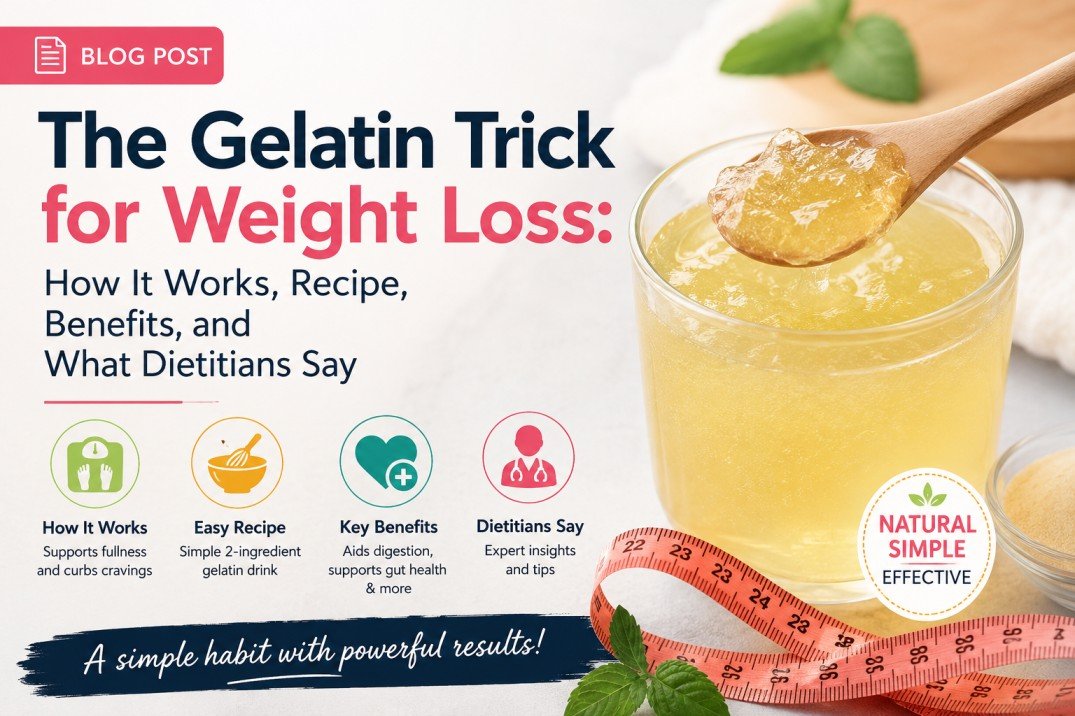
If you’ve been scrolling TikTok or Instagram Reels lately, you’ve probably noticed a new “weight loss hack” popping up everywhere — the gelatin trick. People are claiming that drinking a slightly jiggly gelatin mixture before meals curbs hunger, shrinks portion sizes, and kickstarts weight loss. Some creators have even gone as far as calling it “Nature’s Ozempic.”
So what’s actually true? Does the gelatin trick really work, or is it just another viral trend that will fade in a few weeks? In this article, we’ll break it all down — the science, the recipe, the popular variations, and what registered dietitians actually have to say.
1. What Is the Gelatin Trick for Weight Loss?
The gelatin trick is a simple practice where unflavored gelatin powder is dissolved in water (or another liquid) and consumed 15–30 minutes before a meal. The idea is that the gelatin expands slightly in the stomach and provides protein, helping you feel full sooner and stay full longer — so you eat less at your next meal.
This isn’t a new invention. Bone broth traditions across Northern Europe and East Asia have relied on the same basic principle for centuries — filling up on a low-calorie, high-protein liquid. It’s just been repackaged with a catchy modern name (“the gelatin trick”), which started going viral on TikTok in late 2024 and spread even further through 2025 and 2026.
One important note: this isn’t sweet, flavored Jell-O. It uses unflavored, unsweetened gelatin — no sugar, no artificial flavoring.
2. How Does the Gelatin Trick Work for Weight Loss?
The mechanism behind it is fairly simple — no magic, just basic nutrition science:
- Volume-dependent satiety — drinking a liquid or semi-solid substance before eating physically fills the stomach a bit, sending “full” signals to the brain.
- Protein preload effect — gelatin is a protein. Protein tends to keep you fuller for longer compared to carbs or fat, since it takes more time to digest.
- Glycine content — gelatin is high in an amino acid called glycine, which some studies link to appetite and blood sugar regulation.
In plain terms: the gelatin trick isn’t a fat-burning or metabolism-boosting hack. It’s simply an appetite management tool that may help you eat less at mealtime.
3. Does the Gelatin Trick Really Help You Lose Weight?
Short answer: maybe, but only indirectly.
If drinking a gelatin mixture helps you eat 200–300 fewer calories at dinner, that can add up to a calorie deficit over time — which is the basic principle behind weight loss. Some people who’ve tried it report a drop in their daily calorie intake without feeling extra hungry.
But dietitians are clear that gelatin itself doesn’t “melt fat.” It’s simply a behavioral tool — not unlike drinking a glass of water or eating a salad before a meal. If your overall diet and lifestyle don’t change, the gelatin trick alone is unlikely to produce meaningful or lasting weight loss.
4. What Is the Gelatin Weight Loss Recipe?
The most basic and popular version only needs 3 ingredients:
- Unflavored gelatin powder (1 tablespoon, about 7–8 grams)
- Cold liquid (water, unsweetened cranberry juice, or pomegranate juice)
- Hot water
Some variations also add lemon juice, apple cider vinegar, green tea, or pink Himalayan salt — we’ll cover these in detail further below.
5. How to Make the 3-Ingredient Gelatin Weight Loss Recipe
Ingredients:
- 1 tablespoon unflavored gelatin powder
- ½ cup cold water or unsweetened juice
- ½ cup hot water
Steps:
- Add the gelatin powder to the cold liquid and let it sit for 5 minutes — this is called “blooming.” It should look grainy and swollen.
- Add the hot water and stir briskly for 30–60 seconds until fully dissolved, with no clumps left.
- Drink it right away, or let it cool slightly if you prefer it thicker.
This drink is typically consumed 15–30 minutes before a meal.
6. How to Use Gelatin Before Meals for Appetite Control
Timing and consistency matter for appetite control:
- Drink it 15–30 minutes before your biggest meal (lunch or dinner).
- Don’t use it more than 1–2 times a day.
- Treat it as a “pre-meal appetite check,” not a substitute for a balanced meal — your actual meal should still include protein, fiber, and healthy fats.
- Don’t rely on gelatin alone — if you still eat your usual portion afterward, no calorie deficit is created.
7. When Is the Best Time to Take the Gelatin Trick?
Most people take it before their biggest meal of the day (lunch or dinner), since that’s usually when the risk of overeating is highest. Some people also take it before bed, claiming it reduces late-night cravings — though direct scientific evidence for this specific use is limited.
Best practice: try it before whichever meal is most challenging for you (where you tend to overeat the most), and see how your body responds.
8. Gelatin vs. Collagen: What’s the Difference?
The two are related but not the same:
| Gelatin | Collagen (Hydrolyzed) | |
|---|---|---|
| Source | Made by cooking/heating collagen | Made by enzymatically breaking down collagen |
| Texture | Gels/thickens in liquid | Fully dissolves, doesn’t gel |
| Best use | Gelatin trick drinks, jelly, desserts | Coffee, smoothies |
| Digestion | Slightly slower (because it gels) | Absorbed faster |
The gelatin trick specifically uses gelatin (not hydrolyzed collagen), because its gelling property is what creates the “bulk” in the stomach responsible for the satiety effect.
9. Can Gelatin Help You Feel Fuller and Eat Less?
Yes, to some extent — and this claim is actually backed by science. High-protein preloads (whether gelatin or any other protein source) influence appetite hormones and increase short-term satiety. Registered dietitians generally agree that this satiety effect is real.
That said, the effect varies from person to person. Some people genuinely feel full for 1–2 hours, while others feel hungry again within 60–90 minutes — especially if the drink contains only gelatin with no additional protein or fiber.
10. Does Gelatin Burn Fat or Boost Metabolism?
No. This is the most misleading claim circulating in viral videos. Some social media posts and affiliate marketing sites claim that gelatin stimulates GLP-1 and GIP hormones — the same way prescription medications like Ozempic or Mounjaro do. This claim is scientifically unproven, and registered dietitians clearly push back against it.
Gelatin is a protein source — not a metabolism-boosting or fat-burning ingredient. Its role is purely indirect: if it helps you eat less, that can create a calorie deficit over time, which is the actual driver of weight loss — not any “hormonal trick.”
11. Popular Variations of the Gelatin Weight Loss Trick
Beyond the basic recipe, several variations have gone viral on social media, each adding an ingredient with claimed extra benefits. Let’s look at them one by one.
12. Green Tea Gelatin for Weight Loss
This version uses brewed green tea instead of plain water. Green tea contains catechins and a small amount of caffeine, which may offer mild metabolism support. However, this effect is small, and it doesn’t directly enhance gelatin’s satiety benefit — it’s more of an extra (minor) wellness boost.
13. Lemon Gelatin and Apple Cider Vinegar Gelatin
- Lemon gelatin: Improves taste and adds a small amount of vitamin C, but has no proven direct effect on weight loss.
- Apple cider vinegar (ACV) gelatin: ACV may mildly slow blood sugar spikes when taken with a carb-heavy meal, but research is mixed and the benefit is small. It can also cause acidity or stomach irritation in some people.
14. Pink Salt Gelatin: Does It Really Work?
The “pink gelatin trick” combines gelatin with pink Himalayan salt and cranberry/pomegranate juice (which gives it a pink color). The salt is added for electrolytes — especially useful for people following a low-carb or fasting lifestyle.
But keep in mind: extra salt doesn’t directly do anything for weight loss, and consuming too much can increase sodium intake — which can be risky for people sensitive to blood pressure issues.
15. Coffee Gelatin for Weight Loss
This version mixes gelatin with black coffee. Caffeine can provide short-term appetite suppression and a mild energy boost, which can pair well with gelatin’s satiety effect. However, too much caffeine can cause anxiety, jitters, or sleep disturbances — especially if consumed multiple times a day.
16. Protein-Boosted and Fruit-Infused Gelatin Recipes
Some people add extra whey protein or collagen peptides to the basic recipe to extend the satiety effect — dietitians consider this a smart tweak, since gelatin alone provides relatively little protein (about 6 grams per tablespoon).
Fruits like berries (strawberries, blueberries) can also be added — for fiber, micronutrients, and better taste.
17. Why Has the Gelatin Weight Loss Trick Gone Viral?
There are several reasons behind its viral rise:
- The Ozempic era — with GLP-1 weight loss drugs being expensive and access-limited, people are searching for natural, affordable alternatives.
- Low cost and simplicity — gelatin is cheap and available at any grocery store.
- Satisfying visuals — the jiggly texture and “before/after” transformation videos are algorithm-friendly.
- AI-generated content and influencer marketing — many videos are even AI-generated, which spreads overhyped claims quickly.
18. What Does the Research Say About Gelatin and Weight Loss?
Large-scale clinical trials that specifically prove “the gelatin trick before meals leads to weight loss” are currently limited. The available research is mostly based on two things:
- Protein preload studies — showing that consuming protein before a meal increases short-term satiety and can reduce calorie intake during that meal.
- Glycine research — suggesting glycine may have a mild positive effect on appetite and blood sugar, though human trial evidence is still not particularly strong.
Combining these two areas forms the theoretical basis for the gelatin trick — but direct, robust clinical proof that “gelatin specifically causes weight loss” doesn’t yet exist.
19. Is the Gelatin Trick Safe for Weight Loss?
For most healthy adults, consuming moderate amounts (1–2 tablespoons a day) of plain, unflavored gelatin is generally safe. It’s a food-based protein source, not a drug or synthetic supplement.
But “safe” doesn’t mean “risk-free” — there are a few considerations covered in the next section.
20. Potential Side Effects and Things to Consider
- Bloating or gas — some people experience digestive discomfort from consuming a high-protein liquid.
- Allergic reactions — if you’re allergic to the source of the gelatin (usually beef or pork).
- Nutrient gaps — regularly using gelatin as a meal replacement can mean missing out on essential vitamins, minerals, and fiber.
- Risk of over-reliance — dietitians warn that “tricking” yourself into eating less doesn’t build a healthy long-term relationship with food. This could even trigger disordered eating patterns in some people.
- Marketed supplements — the market now has branded “gelatin trick” supplements making big claims (like “GLP-1 stimulation”). Be cautious of these — most of their claims are unverified.
21. Can Gelatin Be Used as a Meal Replacement?
No, absolutely not. Gelatin lacks carbs, healthy fats, fiber, and most vitamins/minerals. It’s also an incomplete protein (low in certain essential amino acids). Using it as a meal replacement can increase the risk of nutrient deficiencies.
Use it only as an appetite-management pre-meal drink alongside your balanced, nutrient-rich meals — not in place of them.
22. Who Should Avoid the Gelatin Weight Loss Trick?
The following groups should avoid it, or consult a doctor/dietitian first:
- Anyone allergic to gelatin or its source
- Pregnant or breastfeeding women (without medical guidance)
- People with kidney disease or on a protein-restricted diet
- Anyone with a history of disordered or restrictive eating patterns
- People with high blood pressure (especially with salt-added versions)
- Children and teenagers (any “weight loss trick” should be avoided without professional guidance)
23. Gelatin Trick for Weight Loss: Expert Verdict
Registered dietitians’ overall take on this trend is fairly balanced — neither a full endorsement nor a full rejection. Most experts agree that gelatin is a legitimate protein source and that its satiety effect is real. Where they push back is on the overhyped marketing claims — like it “melting fat” or being a “natural replacement for GLP-1 drugs.”
Obesity medicine specialists tend to view it as a “low-cost, low-risk adjunct” — meaning a small, helpful addition, but not a standalone solution.
24. The Bottom Line: Can the Gelatin Trick Really Help You Lose Weight?
The gelatin trick isn’t a miracle cure, but it’s not a complete scam either. It’s a simple, low-cost, low-risk tool that — when used correctly alongside a balanced diet — may help with appetite control and portion management to some degree.
But if someone expects that drinking a gelatin mixture alone, without any other lifestyle changes, will lead to rapid weight loss, those expectations aren’t realistic. Sustainable weight loss requires balanced nutrition, regular movement, good sleep, and consistency — not a single “trick.”
If you’re serious about weight management, consulting a registered dietitian or doctor for personalized guidance is the safest and most effective approach.
FAQs: Gelatin Trick for Weight Loss
1. How long does it take for the gelatin trick to show results?
There’s no fixed timeline. Some people notice reduced hunger and better portion control within 1–2 weeks, but actual weight loss depends on overall calorie deficit and consistency — usually at least 3–4 weeks if diet and lifestyle are also on track.
2. Can I take the gelatin trick every day?
Yes, moderate amounts (1–2 tablespoons a day) are generally safe for most healthy adults. However, don’t use it as a daily meal replacement — treat it only as a pre-meal appetite tool.
3. Is the gelatin trick the same as the Jell-O trick?
No. The gelatin trick uses unflavored, unsweetened gelatin. Jell-O contains sugar and artificial flavors, which work against your weight loss goals.
4. Can vegetarians/vegans try the gelatin trick?
No — traditional gelatin is animal-based (made from beef or pork). Vegetarians/vegans looking for a similar effect can try plant-based gelling agents like agar-agar or pectin, though their nutritional profile is different and there’s very little specific research on them.
5. How many calories does the gelatin trick actually cut?
This varies from person to person. Some anecdotal reports show a 200–350 calorie reduction in daily intake, but this isn’t a scientifically standardized number — it depends on your baseline diet and portion sizes.
6. Can you lose weight with just the gelatin trick and no exercise?
Theoretically, a little, if it creates a calorie deficit. But sustainable and healthy weight loss is generally considered to require movement/exercise, good sleep, and balanced nutrition. Relying on the gelatin trick alone isn’t effective long-term.
7. Are gelatin trick supplements (capsules/powders sold online) safe?
Be cautious. Many branded “gelatin trick” supplements on the market make big claims (like “GLP-1 boost” or “Ozempic alternative”) — most of these claims are unverified. Using plain, simple unflavored gelatin is a safer and more transparent option.
8. Is the gelatin trick safe for children?
It’s not recommended without a doctor’s guidance. Children and teenagers shouldn’t try any “weight loss trick” on their own — their growth and nutritional needs are different from adults’.
Disclaimer: This article is for general informational purposes and is not medical advice. Before trying any new diet trend, especially if you have a health condition, please consult your doctor or a registered dietitian.