






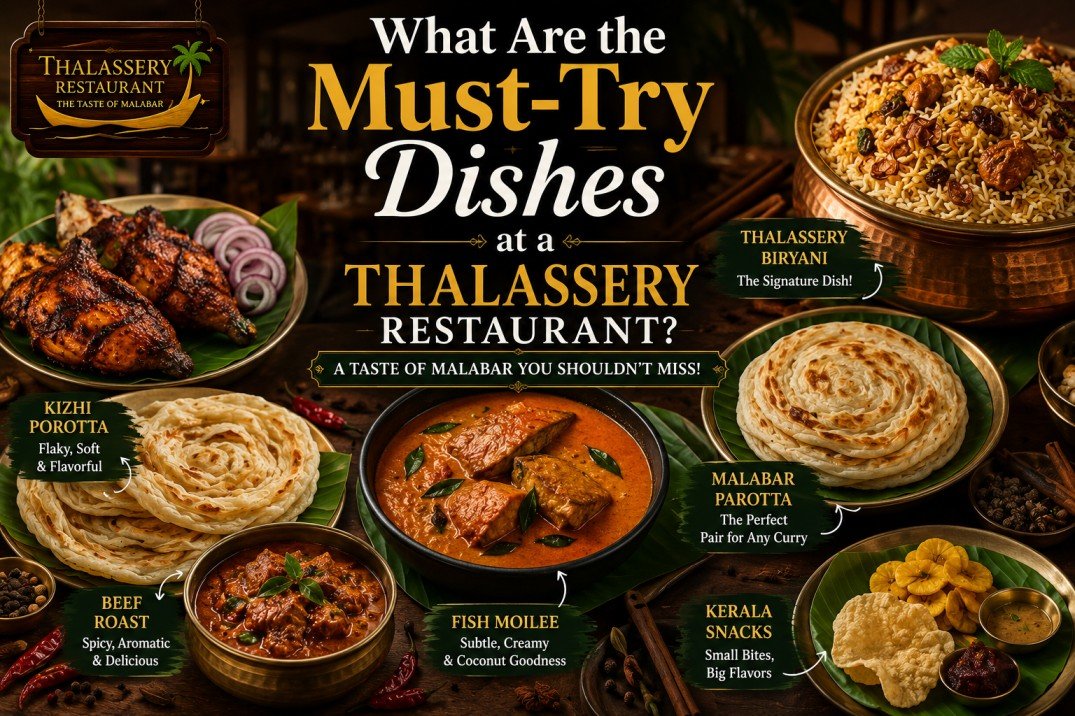
Walking into a Thalassery Restaurant for the first time can be a little overwhelming. The menu spans traditional Malabar staples, a full biryani section, an extensive seafood list, North Indian tandoori items, and even Chinese dishes — all on one card. If you’re new to Kerala’s Malabar cuisine, or simply don’t know where to start, it helps to have a clear sense of which dishes actually define the experience versus which ones are just filler for a broader multi-cuisine crowd.
This guide walks through the dishes worth prioritizing at Thalassery Restaurant, based on what regulars and reviewers across its various Bangalore outlets consistently recommend, along with context on what makes each one distinctive.
1. Thalassery Chicken Biryani
There’s no real debate about where to start. Thalassery-style biryani is the dish the restaurant is named after, and it’s consistently the most recommended item across outlets and reviews.
What makes it different from the biryani you’ll find at most other restaurants is the rice itself. Instead of the long-grain basmati used in Hyderabadi or Lucknowi biryanis, Thalassery biryani is built on short-grain khyma (also called jeerakasala) rice — a smaller, more fragrant grain native to the Malabar region. This rice cooks differently, absorbs spice more intensely, and results in a softer, more tightly packed texture than the fluffier, separated grains typical of other biryani styles.
The chicken itself is usually marinated and layered with a distinct blend of whole spices, fried onions, and ghee, then slow-cooked to let the flavors meld through the rice. Reviewers repeatedly describe it as aromatic and well-balanced rather than overpoweringly spicy, making it approachable even for those who haven’t had Malabar food before. It’s typically served with a small side of raita or a light stew, and sometimes with pickle or pappadam.
If you only try one dish at Thalassery Restaurant, this should be it.
2. Kappa Biryani
For diners looking for something less commonly found elsewhere, kappa biryani is worth seeking out at outlets that offer it. Kappa refers to tapioca (cassava), a staple ingredient in Kerala’s Malabar and central regions, and this dish reimagines the biryani format using boiled, mashed, or diced tapioca instead of rice as the base.
It’s a distinctly regional dish that rarely appears outside dedicated Malabar restaurants, and reviewers who’ve tried it tend to call it out specifically as a standout, precisely because it isn’t something you can easily find at other Kerala or multi-cuisine spots in the city. If you’ve already had the chicken biryani on a previous visit and want to try something more adventurous, this is the dish to go for.
3. Appam with Kadala Curry or Stew
Appam is a lacy, bowl-shaped rice pancake with a soft, slightly spongy center and crisp, delicate edges — a defining item of Kerala’s breakfast tradition, though it’s eaten throughout the day at Thalassery Restaurant rather than confined to a morning-only menu.
It’s almost always ordered alongside a curry, and the two most common pairings are kadala curry (a spiced black chickpea curry, thick and slightly tangy) and a mild coconut-based vegetable or chicken stew. The contrast between the appam’s delicate texture and the richness of the curry is central to why this combination is so consistently recommended in reviews — it’s comforting, not overly heavy, and a genuinely different experience from the rice-and-gravy combinations found at most North Indian or generic South Indian restaurants.
For first-time visitors, this is often recommended as a gentler entry point into Malabar cuisine before moving on to the spicier chicken and seafood dishes.
4. Puttu with Kadala Curry or Banana
Puttu is a steamed cylinder of rice flour and grated coconut, cooked in layers inside a special mold, resulting in a light, slightly crumbly texture. Like appam, it’s a Kerala breakfast staple that Thalassery Restaurant serves throughout the day, and it’s frequently mentioned alongside appam as one of the defining dishes of the menu.
It’s most commonly paired with kadala curry, though some diners prefer it with a simple ripe banana and a drizzle of sugar for a lighter, sweeter version. A few reviewers have noted occasional inconsistency in how well puttu turns out across visits — it can be dry if not steamed correctly — so it’s worth ordering it fresh and hot rather than as a reheated side.
5. Nadan Chicken Curry (Country-Style Chicken)
“Nadan” translates roughly to “country-style” or “traditional,” and nadan chicken curry reflects Kerala home cooking rather than a restaurant-adapted version of chicken curry. It’s built on a base of coconut, curry leaves, and a distinct blend of spices that gives it a deep, dark color and a rich, slightly tangy flavor profile very different from North Indian-style chicken curries.
This dish shows up repeatedly in reviews as a top recommendation, usually paired with appam, Kerala parotta, or plain rice. It’s a good dish to order if you want a genuine sense of what Malabar home-style cooking tastes like, rather than a restaurant reinterpretation aimed at a broader, less specific audience.
6. Chicken Roast
Distinct from the curry, chicken roast at Thalassery Restaurant is a drier, more intensely spiced preparation, typically cooked down until the sauce clings tightly to the chicken pieces rather than forming a thin gravy. It’s often recommended as a pairing with appam or parotta, and several reviewers mention it specifically as one of the dishes that convinced them to become regulars.
If you’re choosing between the curry and the roast, it often comes down to preference: the curry offers more sauce for dipping bread or rice, while the roast delivers a more concentrated, spice-forward bite in every piece.
7. Duck Roast
Duck is less commonly available at most restaurants — Kerala-focused or otherwise — which makes duck roast one of the more distinctive and underrated dishes at Thalassery Restaurant. It’s specifically associated with Kerala’s northern Malabar region, and reviewers who’ve tried it often describe it as a standout precisely because it’s difficult to find elsewhere in Bangalore.
The preparation typically follows the same spice-heavy, slow-cooked approach used for the chicken roast, but duck’s richer, slightly gamier meat gives the dish a different character. If you’ve already worked through the chicken and seafood options on previous visits, this is a good dish to branch out into.
8. Kerala Parotta
Not a dish on its own, but an essential accompaniment. Kerala parotta is a layered, flaky flatbread made by folding and stretching the dough repeatedly before cooking — a technique that produces a distinctly different texture from North Indian parathas, with visible, crisp layers that pull apart easily.
It’s most commonly ordered alongside chicken curry, chicken roast, or beef preparations (where available), and its slightly chewy, buttery texture makes it particularly well-suited to soaking up the thicker Malabar-style gravies. Skipping it in favor of plain rice means missing out on one of the more texturally distinctive elements of a proper Malabar meal.
9. Fish Fry (Mathi Fry or Similar Preparations)
Given Thalassery’s coastal origins, seafood is naturally a strong part of the menu, and simple fish fry preparations — often featuring mathi (sardine) or other regionally available fish — are a good, affordably priced way to sample the seafood offerings without committing to the pricier specialty preparations.
These are typically marinated in a spice blend and shallow-fried until crisp, served as a starter or side rather than a main course. Reviewers frequently mention fish fry alongside appam and chicken curry as part of a well-rounded order for a first visit.
10. Karimeen Pollichathu (For a Special Occasion)
For diners willing to spend a bit more, karimeen pollichathu is one of the true specialty dishes on the menu, though it’s only available at some outlets given its premium pricing. Karimeen, or pearl spot fish, is marinated in a spice paste, wrapped in a banana leaf, and slow-cooked — a preparation method that both flavors the fish and keeps it moist, while the banana leaf imparts a subtle, smoky aroma.
This dish sits at the higher end of the price range compared to the rest of the menu, generally running notably more than the everyday staples, but it’s frequently recommended by reviewers as worth the splurge for anyone wanting to experience a genuine Kerala seafood specialty rather than a more generic fish preparation. If you’re visiting with a special occasion in mind, or simply want to treat yourself, this is the dish to order.
11. Netholi Fry (Anchovy Fry)
A smaller, more humble seafood dish, netholi fry features tiny anchovies marinated and fried until crisp. It’s typically ordered as a starter or side dish rather than a main course, and its intensely savory, slightly briny flavor makes it a good pairing with a simple rice-and-curry meal. It’s a good option for seafood lovers who want to try something beyond the more commonly available fish fry and fish roast options.
12. Sulaimani
To round out a meal, sulaimani is the drink of choice. This is a spiced, lightly sweetened black tea — no milk — flavored typically with cardamom, cloves, and sometimes a hint of lemon or ginger, reflecting the strong Arab trade influence on Malabar’s culinary traditions.
It’s consistently mentioned in reviews as the ideal way to finish a spicy meal, offering a light, warming contrast to the richness of the curries and roasts. If you’ve never had sulaimani before, ordering it after a heavier dish like biryani or chicken roast is the best way to appreciate what it adds to the overall meal.
How to Structure a First Visit
If you’re visiting Thalassery Restaurant for the first time and want to sample a representative range of the menu without over-ordering, a reasonable approach is:
- Start with: Appam paired with kadala curry or a light stew, to ease into the cuisine’s flavors.
- Move to the main event: Thalassery chicken biryani, the single most-recommended dish across virtually every outlet.
- Add a roast or curry: Nadan chicken curry or chicken roast, paired with Kerala parotta if you want to skip rice for a course.
- Try a side of seafood: A simple fish fry, which is affordable and gives a good sense of the seafood offerings without a big commitment.
- Finish with: A cup of sulaimani to close out the meal.
For a second visit, once you’ve got the basics covered, branching out into kappa biryani, duck roast, netholi fry, or — if your budget allows — karimeen pollichathu is a good way to explore the more distinctive, harder-to-find dishes on the menu.
A Few Things to Keep in Mind
Because Thalassery Restaurant operates across many independently run outlets in Bangalore, dish availability and quality can vary somewhat by location. Not every branch offers the full range described here — kappa biryani and karimeen pollichathu, in particular, tend to be available only at select outlets — so it’s worth checking the specific menu at your nearest branch before planning a visit around a particular dish. Similarly, a few reviewers have noted occasional inconsistency with dishes like puttu, which depend heavily on being freshly steamed rather than sitting for a while before being served. Ordering during less busy hours, when possible, tends to result in fresher, better-executed versions of these more delicate preparations.
Final Thoughts
The strength of Thalassery Restaurant’s menu lies in its regional specificity — dishes like the short-grain biryani, kappa biryani, duck roast, and sulaimani reflect a genuine Malabar culinary identity rather than a generalized version of Kerala food. While the menu does stretch into North Indian and Chinese territory to accommodate broader tastes, the dishes worth prioritizing are almost entirely the traditional Malabar items: the biryani, the breakfast staples of appam and puttu, the home-style curries and roasts, and the distinctive seafood preparations. Ordering along these lines, rather than defaulting to the more generic multi-cuisine sections of the menu, is the best way to get a genuine sense of what makes Thalassery Restaurant worth visiting in the first place.
Frequently Asked Questions
1. What is the single most recommended dish at Thalassery Restaurant?
Thalassery-style chicken biryani, made with short-grain khyma rice, is by far the most consistently recommended dish across outlets and reviews.
2. What makes Thalassery biryani different from other biryanis?
It uses short-grain khyma rice instead of long-grain basmati, along with a distinct Malabar spice blend, resulting in a different texture and flavor from Hyderabadi or Lucknowi-style biryanis.
3. Is kappa biryani available at every outlet?
No, it tends to be offered only at select branches, so it’s worth checking the menu at your specific nearby location if you want to try it.
4. What should a first-time visitor order?
A good starting combination is appam with kadala curry or stew, the Thalassery chicken biryani, a chicken curry or roast with Kerala parotta, and sulaimani to finish.
5. Are there good vegetarian options among the must-try dishes?
Appam and puttu paired with kadala curry are strong vegetarian choices, along with vegetable stew, though the menu overall leans non-vegetarian.
6. What’s the difference between chicken curry and chicken roast?
Chicken curry is a saucier preparation meant for dipping rice or bread, while chicken roast is cooked down until drier and more intensely spiced, with less gravy.
7. Is karimeen pollichathu worth the higher price?
Many reviewers consider it worth the splurge, since it’s a genuine Kerala seafood specialty — banana-leaf-wrapped, spice-marinated pearl spot fish — not commonly available at other restaurants.
8. What is sulaimani, and why is it recommended?
Sulaimani is a spiced, milk-free black tea associated with Malabar’s culinary tradition, often recommended as a light, warming way to finish a spicy meal.
9. Why is duck roast considered a must-try?
Duck is uncommon at most restaurants, and the dish reflects a specific northern Malabar tradition, making it a distinctive option for diners wanting to try something beyond chicken and seafood.
10. Does dish quality vary by outlet?
Yes. Since outlets operate somewhat independently, some dishes — particularly delicate ones like puttu — can vary in quality depending on the branch and how busy it is at the time.