






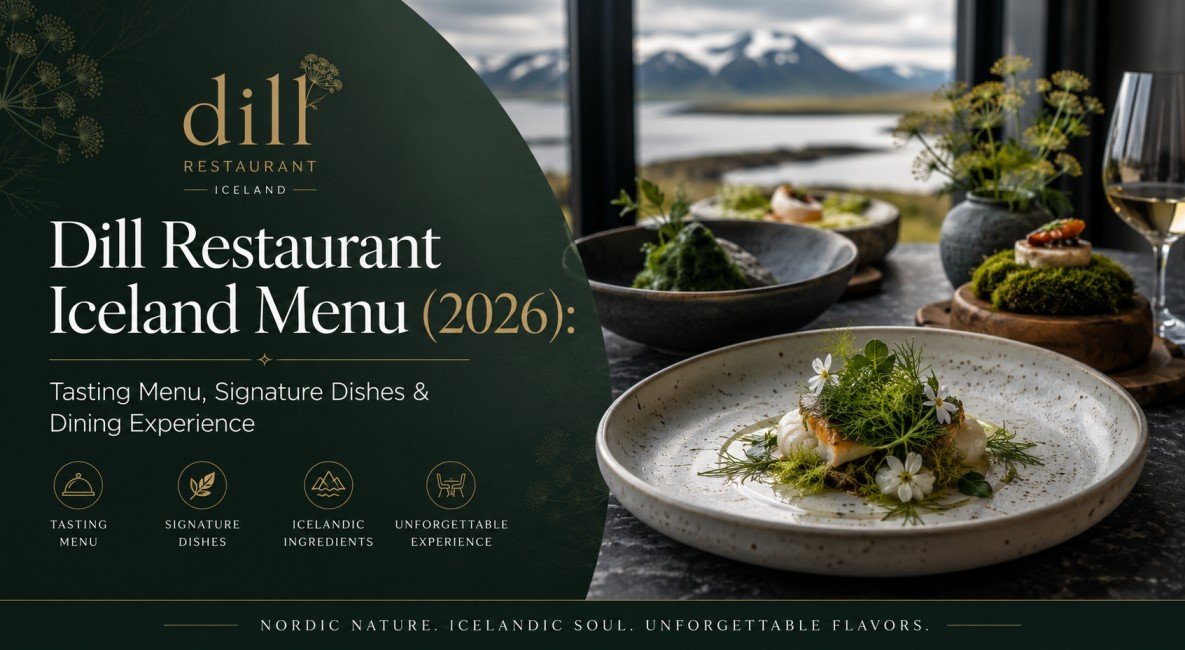
Tucked above a spiral staircase on Reykjavík’s main shopping street, Dill Restaurant remains the single most important address in Icelandic fine dining. It was the first restaurant in the country to earn a Michelin star, and it has since added a Michelin Green Star for its sourcing practices — a rare double distinction that reflects both the quality of the cooking and the philosophy behind it. For anyone planning a trip to Reykjavík in 2026 and wondering whether Dill is worth the splurge, here is a full breakdown of the menu, the pricing, the food, and what an evening there actually looks like.
A Brief History: How Dill Changed Icelandic Food
Dill opened in 2009 under chef Gunnar Karl Gíslason, at a moment when Icelandic dining was still dominated by imported ingredients and continental technique. Gíslason took the opposite approach. Rather than shipping in truffles, olive oil, or French butter, he built the entire menu around what Iceland itself produces — its lamb, its seafood, its dairy, and its extraordinary range of wild, foraged plants, mosses, and berries. That decision to work exclusively with Icelandic soil and Icelandic waters became the restaurant’s defining principle, and it is still the rule the kitchen follows today.
The bet paid off. In 2017, Dill became the first restaurant in Iceland to receive a Michelin star, a milestone widely credited with energizing Reykjavík’s entire restaurant scene and putting New Nordic cuisine on the international map for Icelandic chefs. Gíslason later spent several years cooking in New York, earning a second Michelin star at Agern inside Grand Central Station, before returning home and rebuilding Dill at its current location on Laugavegur 59. Today, Dill remains Iceland’s only Michelin-starred restaurant, and it holds a Michelin Green Star as well, recognizing its commitment to foraging, upcycling, and sustainable sourcing.
The Setting: What the Dining Room Feels Like
Dill is small and deliberately so. The dining room seats roughly 30 guests per service, with an open kitchen that lets diners watch the cooks at work in a tight, focused space. The atmosphere leans toward raw wood, soft lighting, and understated design rather than anything flashy — the sort of room that signals confidence without needing to shout about it. Tables are spaced generously, service is knowledgeable but relaxed, and the overall mood favors quiet immersion in the food over spectacle.
The restaurant keeps a tight schedule. Dill is open Wednesday through Saturday only, with a single evening seating that begins around 18:00, and it is closed Sunday through Tuesday. There is no lunch service and no walk-in seating — every table is reserved in advance, typically through the restaurant’s online booking system or by email, and popular dates can book out weeks or even months ahead. If a trip to Reykjavík is on the calendar, securing a Dill reservation early is one of the first things worth doing.
The Tasting Menu: Structure and Format
Dill serves a single tasting menu rather than an à la carte selection, and it is built entirely around the seasons. According to the restaurant, the current menu is priced at 39,900 ISK per person, which places it firmly in the category of a special-occasion, once-in-a-trip meal rather than a casual dinner out.
The exact number of courses shifts with the seasons and with what foragers, fishermen, and small farms are bringing in that week, but diners can generally expect somewhere between roughly seven and fifteen-plus stages over the course of the evening, depending on how the kitchen structures a given night’s menu. Reviewers frequently describe the meal as a long, unfolding sequence of small, intensely flavored plates rather than a handful of large courses — closer to a tour through Icelandic ingredients than a conventional dinner.
Because the entire menu changes with the seasons, there is no fixed, printed course list that stays the same year-round. What stays consistent is the philosophy: fermentation, smoking, and pickling techniques applied to ingredients gathered from Icelandic land and sea, presented with a level of technical polish that draws directly on Gíslason’s classical training.
Signature Dishes and Ingredients
While the specific line-up changes with the calendar, certain ingredients and techniques recur often enough to count as house signatures, and they give a strong sense of what a night at Dill actually tastes like:
- Skyr and dill oil — a cool, precise opening course built from Iceland’s signature cultured dairy product, often used as the meal’s first bite to set the tone.
- Langoustine from Höfn — barely cooked and paired with broths built from fermented barley and wild hillside herbs, showcasing the restaurant’s fermentation work.
- Scallops from Breiðafjörður — hand-harvested and served with minimal intervention to let the ingredient’s natural sweetness carry the dish.
- Whelk with spruce oil — a distinctly Icelandic pairing of shellfish with the resinous, woodsy notes of native spruce.
- Chawanmushi with whelk — a Japanese-technique egg custard reworked with Icelandic shellfish, an example of how the kitchen borrows global technique while keeping ingredients local.
- Svið — a modern reinterpretation of the traditional Icelandic dish of sheep’s head, presented in a refined format alongside offal.
- Lamb dishes, including a gingersnap made with lamb lard — an example of the kitchen’s habit of using every part of an animal in unexpected ways.
- Skate with brown butter — a nod to Iceland’s long tradition of preserving and fermenting fish, given a French technical treatment.
- Skyr parfait — a dessert that often closes the meal, returning to the same skyr that opened it but transformed into something richer and more indulgent, tying the whole tasting menu together.
Ingredients like lumpfish roe, crowberries, wild moss, and burnt hay show up across seasons as well, underscoring how central foraging is to the kitchen’s identity. Dill works directly with small producers — seaweed foragers, organic barley farmers, and independent fishermen — rather than large-scale suppliers, which is part of why the Michelin Guide singled out the restaurant’s sourcing for its Green Star recognition.
Beverage Pairings
Dill offers three tiers of drink pairing to accompany the tasting menu, each designed to track the arc of the meal from delicate seafood courses through to dessert:
- Wine and beverage pairing — 21,300 ISK: A full pairing built from organic and often biodynamic wines, selected by the restaurant’s sommelier team to match the unconventional, ingredient-driven style of the food. Dill’s wine list leans toward small, natural producers who share the kitchen’s minimal-intervention philosophy rather than mainstream, big-name labels.
- Mixed beverage pairing — 19,300 ISK: A combination of wine, craft beer, and house-made non-alcoholic drinks, aimed at guests who want variety across the meal rather than wine with every course.
- Alcohol-free pairing — 13,900 ISK: A lineup of herbal infusions, house-made juices, and other non-alcoholic drinks built specifically to complement each stage of the tasting menu — a genuinely considered option rather than an afterthought for guests who aren’t drinking.
Guests can also choose to skip pairings altogether and dine on the tasting menu alone.
Dietary Restrictions and Allergies
Because of how tightly the menu is constructed — with courses often depending on specific dairy or protein components — Dill is not able to accommodate vegan diners or guests who need a menu entirely free of milk protein. The kitchen can, however, work around most standard allergies and intolerances as long as guests inform the restaurant when booking, giving the team time to adjust individual courses. Anyone with dietary restrictions should flag them clearly at the time of reservation rather than on arrival.
Reservations: What to Know Before Booking
Dill takes reservations through its website and third-party booking platform rather than accepting walk-ins, and with only around 30 seats per service and just four nights of service each week, tables disappear quickly — especially during the busy summer travel season and around holidays. A few practical tips for anyone planning to eat there:
- Book several weeks ahead, and further out if the visit falls during peak summer months or holiday periods.
- Decide on a pairing in advance if possible, since it’s easier to select a beverage package at the time of booking than to negotiate it on arrival.
- Flag allergies and dietary needs at booking, not at the table, since the kitchen needs lead time to adjust courses.
- Expect a multi-hour evening. Reviewers consistently describe the meal as unfolding over several hours across many small courses, so it’s worth keeping the rest of the evening’s plans light.
- Budget for the full experience. Between the 39,900 ISK menu and a wine pairing at 21,300 ISK, dinner for two with pairings can run well past 120,000 ISK before service charges — a number worth planning for rather than being surprised by.
Is Dill Worth It?
For diners who want to understand Icelandic cuisine at its most ambitious, Dill is generally considered close to essential. It is not a restaurant built around comfort-food nostalgia or crowd-pleasing plates — dishes built around fermented shark, sheep’s head, or lamb offal are presented proudly rather than softened for tourists, and the kitchen leans into ingredients that some visitors will never have encountered before arriving in Iceland. That approach is precisely why food writers and guidebooks continue to single it out: it offers a genuinely different tasting menu experience from what’s available almost anywhere else, built entirely from what one small North Atlantic country can grow, raise, forage, and pull from its own coastal waters.
For visitors weighing whether to spend an evening — and a meaningful chunk of a travel budget — at Dill, the restaurant’s reputation, its rare Michelin star-and-Green-Star combination, and its unwavering commitment to Icelandic-only ingredients make a strong case that this is one of the more distinctive fine-dining experiences in the Nordic region, and arguably the single best introduction to what modern Icelandic cooking is capable of.
Frequently Asked Questions
1. How much does the tasting menu cost at Dill Restaurant?
The core tasting menu costs 39,900 ISK per person. Beverage pairings are optional and priced separately.
2. Are beverage pairings available, and what are the options?
Yes — a Wine and Beverage Pairing (21,300 ISK), a Mixed Beverage Pairing (19,300 ISK) combining wine, craft beer, and non-alcoholic drinks, or an Alcohol-Free Pairing (13,900 ISK) of herbal infusions and house-made juices.
3. How many courses are in the tasting menu?
The count changes with the season, typically ranging from around seven courses up to fifteen or more small stages.
4. Does Dill Restaurant accommodate vegan or dairy-free diets?
No. The kitchen cannot accommodate vegan guests or menus completely free of milk protein. Other allergies can usually be handled with advance notice.
5. Do I need a reservation, and how far ahead should I book?
Yes — walk-ins aren’t accepted. Book several weeks ahead, and further out during summer and holidays, since the restaurant seats only around 30 guests per service.
6. What days and hours is Dill open?
Wednesday through Saturday, dinner only, with a single evening seating around 18:00. Closed Sunday through Tuesday.
7. Where is Dill Restaurant located?
Laugavegur 59, 101 Reykjavík — within easy walking distance of most hotels in the city center.
8. Is Dill Restaurant Michelin-starred?
Yes — Iceland’s only Michelin-starred restaurant, star awarded in 2017, plus a Michelin Green Star for sustainable sourcing.
9. What kind of food does Dill serve?
Modern Icelandic (“New Nordic”) cuisine built entirely from Icelandic ingredients — seafood, lamb, dairy, and foraged herbs, moss, and berries — with no imported produce.
10. How much should I budget for dinner at Dill?
The tasting menu alone is 39,900 ISK per person. Adding a wine pairing brings it to roughly 61,200 ISK per person before service — so a couple with wine pairings should budget well over 120,000 ISK for the evening.