






Ask ten Keralites which biriyani they’d fight for, and at least seven will say Thalassery. It isn’t the loudest biriyani on the plate — no fiery red oil, no overpowering masala — yet it’s the one people drive across town for. The catch is that almost every “Malabar” restaurant now claims the Thalassery name, and most of them are serving a shortcut version.
This guide breaks down exactly what separates a real Thalassery restaurant from a copycat, so your next biriyani craving doesn’t end in disappointment.
Why Thalassery Cooking Tastes Different From Every Other Biriyani
Thalassery sits on Kerala’s Malabar coast in the Kannur district, and for centuries it functioned as a working port — traders from Arabia, Persia, Portugal, Holland, and France all passed through, and each left something behind in the kitchen. That’s the real reason the cuisine tastes the way it does: it’s layered history, not a single recipe.
Three things define the style:
It chases fragrance, not fire. Most restaurant-goers expect biriyani to hit them with chili first. Thalassery cooks go the opposite way — cardamom, cloves, fennel, cinnamon bark, and star anise are toasted and built into the base, so the dish smells rich long before it tastes spicy.
Everything is cooked in stages. Nothing goes into the pot raw and hopeful. The meat is simmered in its masala until it’s nearly falling apart, and the rice is cooked separately in ghee, before the two are ever combined.
Dum sealing is non-negotiable. The final pot is sealed — traditionally with dough, sometimes with a tight lid and cloth — and left over low coals or a low flame so the rice finishes cooking in captured steam, pulling in flavor from the meat below it.
What’s Actually in the Pot: The Real Anatomy of Thalassery Biriyani
If you’ve only had Hyderabadi or Kolkata-style biriyani, a few things will surprise you.
The rice isn’t Basmati. It’s Kaima, also called Jeerakasala — a short, slender grain grown mostly in Kerala. It’s naturally aromatic even before spices touch it, and because the grains are small, they soak up ghee and meat stock far more aggressively than long-grain rice does.
The masala is cooked, not marinated. Unlike biriyanis where raw marinated meat goes straight into the pot, Thalassery masala is a finished, thick gravy in its own right before the rice ever meets it. That’s why the meat tends to be softer and more deeply flavored.
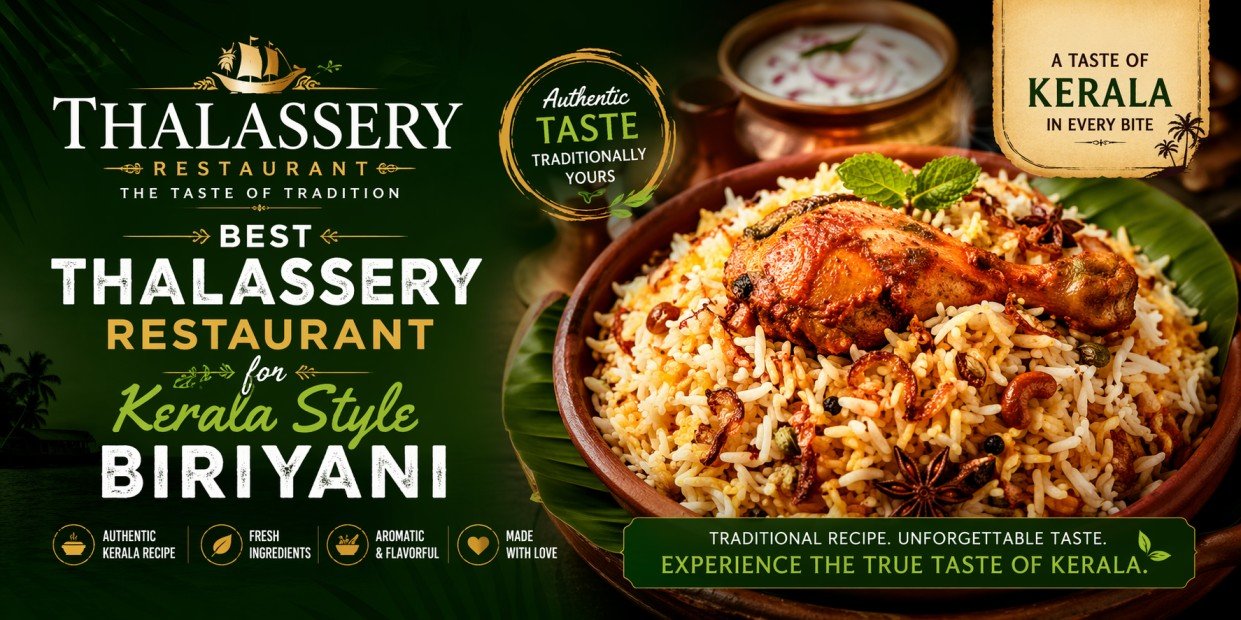
The topping is a build, not a garnish. Deep-fried onions (locally called bista), roasted cashews, and plump raisins go on top in real quantity — not a token sprinkle. They add crunch and a light sweetness that balances the savory rice underneath.
It sits lighter than you’d expect. Less oil, fresher spice grinding, and a shorter ingredient list than heavier regional biriyanis mean most people don’t feel weighed down after a full plate.
Beyond Biriyani: What Else to Order at a Genuine Thalassery Restaurant
A kitchen that only does biriyani well probably isn’t the real deal. Look for these on the menu too:
- Malabar Parotta with Chicken Roast — Thin, flaky layered parottas next to a dry-roasted, well-spiced chicken. This combination alone is worth the visit.
- Pathiri — Delicate rice-flour flatbreads, almost paper-thin, meant to be torn and dipped into mutton or fish curry.
- Meen Curry (Thalassery Fish Curry) — Built on coconut milk and kudampuli (Malabar tamarind), giving it a tang you won’t find in any other regional fish curry.
- Arikadukka — Mussels stuffed with a spiced rice-and-coconut filling, steamed, then pan-fried until the shell edges crisp up. A classic Kannur evening snack.
- Unnakaya — A sweet, deep-fried banana dumpling stuffed with a coconut-cashew-raisin filling. Worth ordering just to see if it’s on the menu at all — most places that skip it are skipping authenticity too.
Five Ways to Tell a Real Thalassery Restaurant From a Copycat
Plenty of places print “Malabar Style” on the signboard without doing any of the actual work. Use these checks:
- Ask what rice they use. If the answer is Basmati, it’s not Thalassery biriyani — full stop. Kaima or Jeerakasala rice is the one non-negotiable ingredient.
- Check what comes on the side. Real Thalassery biriyani is served with a sweet-and-tangy date pickle (inji-pazham achar), a coconut-mint chutney, and a light raita — not a thick red salan.
- Smell before you taste. If the first thing that hits you is chili heat rather than warm spice aroma, the kitchen has taken shortcuts.
- Look for the weekend specials. Genuine Malabar kitchens rotate in dishes like Unnakaya, Mutta Mala, or Neypathal on weekends — items that don’t sell in huge volume but signal a kitchen that actually knows the region’s food.
- Watch how the rice separates. Authentic Kaima rice grains stay short, fluffy, and mostly separate. If the rice looks long, sticky, or clumped, it’s Basmati wearing a Thalassery label.
Frequently Asked Questions
How is Thalassery biriyani different from Hyderabadi biriyani?
Hyderabadi biriyani is built on long-grain Basmati rice with raw marinated meat cooked together with the rice from the start, and it leans on a heavier chili profile. Thalassery biriyani uses short-grain Kaima rice, meat that’s pre-cooked into a finished masala, milder aromatic spicing, and a generous topping of fried onions, cashews, and raisins.
Is Thalassery food too mild or too spicy for kids?
It sits comfortably in the middle. The heat comes mostly from green chilies rather than red chili powder, so it reads as warm and flavorful rather than sharp — most children handle it fine, though you can always ask the kitchen to go lighter.
Are there good vegetarian options at a Thalassery restaurant?
Yes. Look for Malabar vegetable kurma, neypathal (ghee-fried rice puris), and vegetable biriyani made with the same Kaima rice — all common on a genuine Malabar menu even though the cuisine is best known for meat and seafood.
How can I tell if the “Dum” process was actually used?
Ask if the biriyani is cooked to order or held in bulk. True dum-cooked biriyani takes 30-45 minutes and is usually only available in limited quantities per sitting — a place serving it instantly, all day, in unlimited portions is almost certainly skipping the sealed slow-cook step.
Final Word
A real Thalassery restaurant isn’t defined by how much red color is in the rice — it’s defined by the rice itself, the slow layering, and a handful of small details most places don’t bother getting right. Next time you’re picking where to eat, run through the checklist above before you sit down. Your plate — and your nose — will tell you the rest.